
Measurement Principle
The laser vibrometer measurement principle: Mach-Zehnder interferometer and the Doppler effect.
3 min readLaser Doppler Vibrometry – Technology
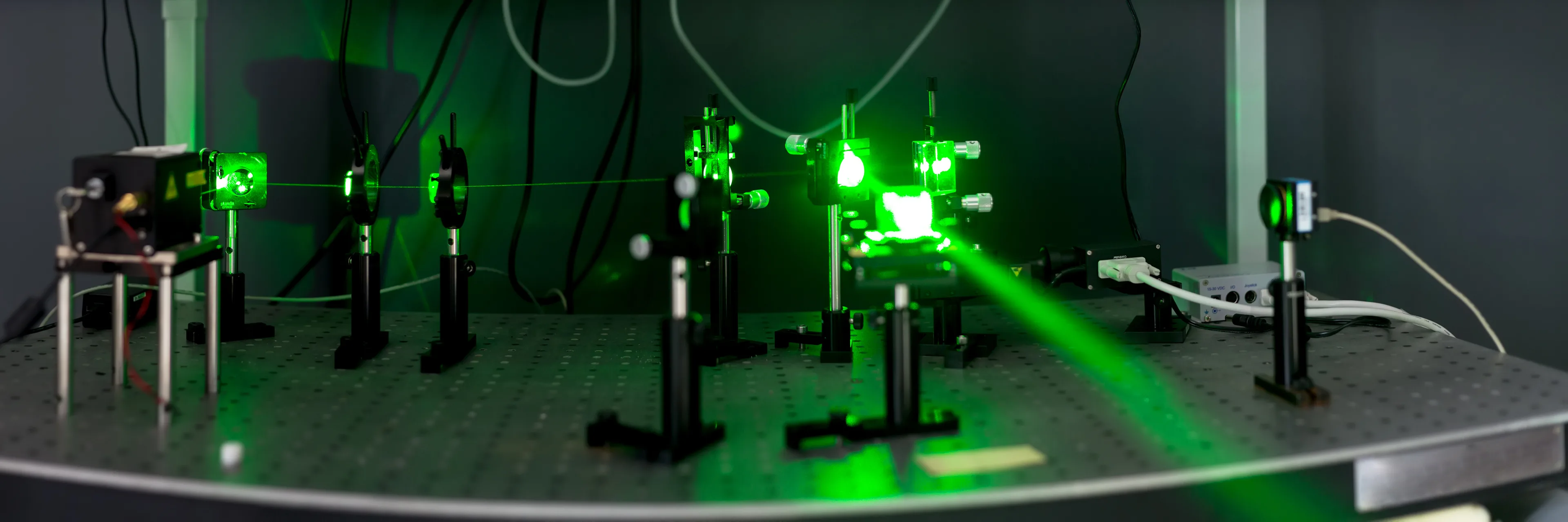
The Measurement Principle of Laser Vibrometry
Light backscattered from a moving object undergoes a velocity-dependent frequency shift (Doppler effect). An interferometer measures this frequency shift with high accuracy, allowing the vibration data to be determined.
Doppler Effect
When waves are emitted by an approaching (receding) source, successive wave crests reach the receiver at shorter (longer) intervals than those at which they were emitted. This phenomenon, perceived as a change in frequency, is known as the Doppler effect. Its acoustic equivalent can be heard, for example, as the apparent change in pitch of an emergency vehicle’s siren as it passes. The measured frequency shift ΔfSpeed of light of a laser with wavelength λSpeed of light is, to a very close approximation, proportional to velocity v for practical vibrometry applications,
Frequency shiftSpeed of light = 2 times velocity over wavelengthSpeed of light .
Vibrometry
The measurement principle is based on using the measured frequency shift to determine the velocity v(t) of the surface from which the laser light is backscattered. Displacement d(t) and acceleration a(t) can also be derived from this. For a harmonic vibration with frequency f and displacement d(t) = D sin(2π f t), the amplitudes D, V and A of displacement, velocity and acceleration are related as follows:
Amplitude equals 2Pi f V = 4π² f² D .
Interferometer
The frequency changes are converted by a Mach-Zehnder interferometer into an intensity signal with a frequency range suitable for further electronic processing. In the interferometer, a beam splitter divides the laser beam into a reference beam and a measurement beam. The measurement beam reflected by the test object is then superimposed on the reference beam. In addition to the sum of the respective intensities of the reference beam ISpeed of light, and the reflected light IVelocity, also includes a component that depends on the optical path length difference Δz between the two beams,
Intensity at time t equals initial intensitySpeed of light plus initial intensityVelocity plus 2 times initial intensitySpeed of light initial intensityVelocity)1/2cosine of 2 timesPi change in displacement over wavelength.
Heterodyne Measurement Principle
The change in intensity caused by the motion of the measurement object is independent of whether the object is moving toward or away from the measuring device. This ambiguity is eliminated using a heterodyne technique, in which the frequency of the reference beam is shifted by a fixed amount f using an acousto-optic couplerBeam. When the measurement object is stationary, interference between the two beams produces an intensity pattern with a frequency fBeam, corresponding to the frequency difference between the reference and measurement beams.
This carrier signal ∝ cos (2 π fBeam) is modulated by the motion of the measurement object. Depending on the direction of motion, the frequency of the light-dark transitions shifts to higher or lower frequencies.
Demodulation
Information about the motion of the measurement object is obtained by demodulating the intensity pattern. After conversion into a digital signal, high-performance real-time signal processing determines the displacement and velocity of the measurement object's surface. Both velocity and displacement can be demodulated.