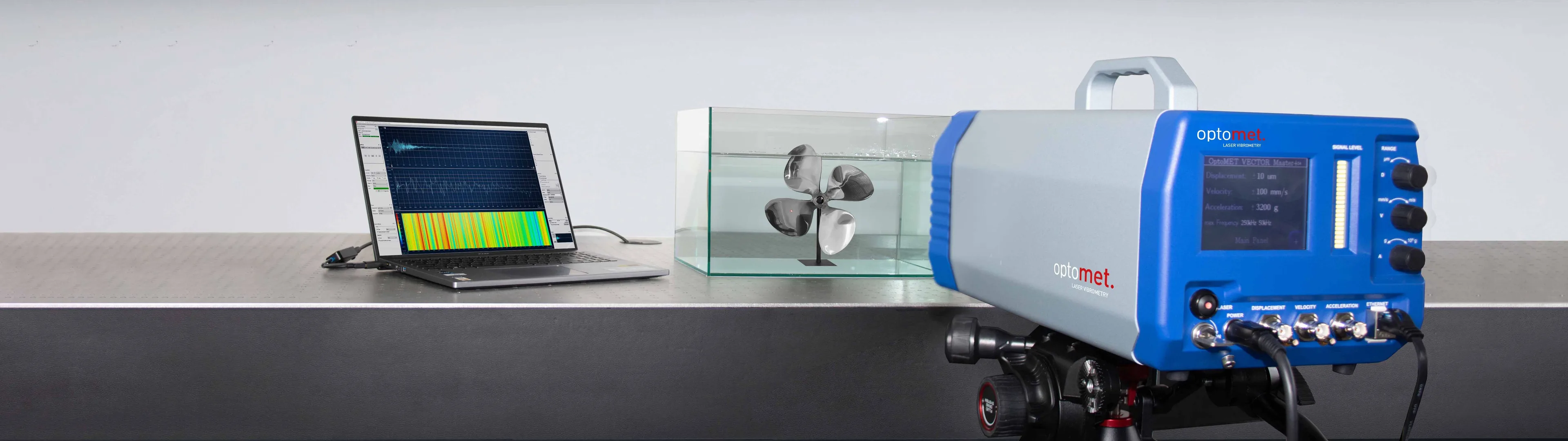
HeNe laser vibrometers.
- Measurements through liquids: The 632.8 nm wavelength is barely absorbed by water, making it ideal for measurements through water, biological fluids, or transparent media.
- Smallest spot sizes: HeNe lasers achieve spot sizes as small as 3 µm – ideal for vibration measurements on microstructures.
- Low thermal impact on components: The low laser power of less than 1 mW minimizes heat absorption by the test object – beneficial for sensitive MEMS and thermally sensitive structures.
Helium-neon laser vibrometers (HeNe) use visible red laser light with a wavelength of 632.8 nm. They enable precise vibration measurements through liquids and achieve exceptionally small spot sizes for microstructure applications.
What is a HeNe laser vibrometer?
A HeNe laser vibrometer is a non-contact instrument for measuring vibrations. Its measurement principle is based on the Doppler effect: The laser beam is directed at a vibrating surface, and the frequency shift of the reflected light is proportional to the vibration velocity of the surface.
HeNe stands for helium-neon and refers to a gas laser that emits light in the visible red spectral range. Optomet HeNe laser vibrometers operate at a wavelength of 632.8 nm, which is visible to the human eye and offers physical properties that are advantageous for certain measurement tasks.
The shorter wavelength enables exceptionally small spot sizes of approximately 3 µm, making it ideal for measurements on microstructures. In addition, light at 632.8 nm is barely absorbed by water, enabling measurements through liquids. The low laser power of less than 1 mW minimizes the thermal load on sensitive components.
Technical specifications:
| Value | |
|---|---|
| Measurement laser wavelength | 632.8 nm (visible, red) |
| Aiming laser | Not required (measurement laser is visible) |
| Measurement laser class | Class 2, < 1 mW |
SWIR or HeNe?
SWIR (1550 nm) is the standard choice for most applications – particularly for dark surfaces, fiber-reinforced composites, and long measurement distances. SWIR also provides a significantly higher signal-to-noise ratio.
HeNe (632.8 nm) is suitable for measurements through water or other liquids, as SWIR radiation is strongly absorbed by them.
Typical applications of a HeNe laser vibrometer
The physical properties of HeNe lasers—low absorption in water, a small spot size, and low laser power—make them suitable for specific measurement tasks.
Measurements through water and other liquids
SWIR radiation at 1550 nm is strongly absorbed by water. HeNe lasers at 632.8 nm pass through aqueous media with low attenuation.
This enables vibration measurements on submerged objects or through liquids—for example, in medical technology, biology, or underwater acoustics.
MEMS and microstructures
A small spot size is crucial when measuring MEMS structures (Micro-Electro-Mechanical Systems), such as cantilevers, resonators, or micromirrors.
HeNe lasers achieve spot sizes in the 3 µm range. Their low laser power minimizes thermal stress—even slight heating can cause sensitive microstructures to deform.
Both laser technologies have their merits—the right choice depends on the application. The following table summarizes the key differences.
Comparison: HeNe vs. SWIR laser vibrometers
 |  | |
|---|---|---|
| Wavelength | 632.8 nm (visible, red) | 1550 nm (invisible) |
| Laser class | Class 2, < 1 mW | Class 1, < 10 mW |
| Safety glasses required | No | No |
| Backscatter characteristics | On metallic and reflective surfaces | Better on dark, matte, and fiber-reinforced surfaces |
| Backscatter characteristics | Limited on challenging surfaces | Better backscatter on black, matte, and fiber-reinforced surfaces |
| Surface preparation | Retroreflective tape or spray required depending on the surface | Generally not required |
| Measurement through liquids | Yes – low absorption at 632.8 nm | No – high absorption at 1550 nm |
| Measurement on hot surfaces | Limited – thermal emission may cause interference | Yes – unaffected by thermal radiation |
| Long measurement distances | Limited | Yes – over 300 m (e.g., bridges, rotors, façades) |
| Frequency bandwidth | DC – 25 MHz | DC – 50 MHz (SMART Series) |
| Max. vibration velocity | Up to 10 m/s | Up to 50 m/s (SMART Series) |
| Laser source lifetime | Limited – HeNe tube ages (approx. 10,000 h) | Long – no regular replacement required |
| Spot size (with identical optics) | Smaller due to shorter wavelength (by a factor of 2 to 2.5) | Larger due to longer wavelength |
| Optomet products | Vector Series, HeNe scanning vibrometer | SMART Series, Nova Series, Fiber Series |
Optomet laser vibrometers with HeNe lasers
Optomet offers HeNe laser vibrometers for applications requiring a visible laser beam or an exceptionally small spot diameter. These products are part of the CLASSIC Series.
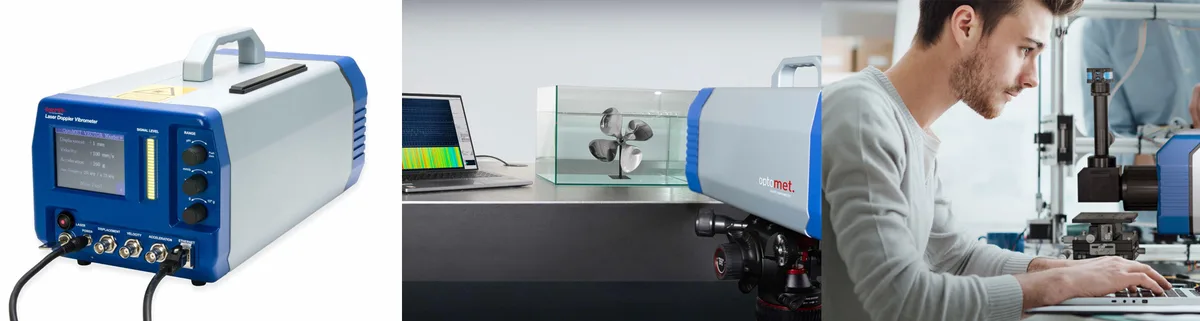
Vector Series
The Vector Series is Optomet's product line for HeNe-based single-point laser vibrometry. Its comparatively short wavelength (632.8 nm) allows the laser beam to be focused to a very small spot diameter. The Vector Series enables non-contact vibration measurements on objects ranging from microscopic to macroscopic in size.
| Description | |
|---|---|
| Vector Standard | Single-point vibrometer with a visible HeNe laser for measurements through liquids and on reflective surfaces |
| Vector Micro-Optics | Specialized system for measurements on extremely small objects, featuring an approx. 3 µm laser spot and an integrated 4K camera |
| HeNe scanning vibrometer | Scanning system with an HeNe laser for full-field vibration analysis of small objects and printed circuit boards |
FAQ: HeNe Laser Vibrometer
When should a HeNe laser vibrometer be used?
HeNe laser vibrometers are the right choice for two main applications:
- Measurements through liquids: At 632.8 nm, absorption in water is low. By contrast, SWIR radiation (1550 nm) is strongly absorbed.
- Measurements on microstructures: The shorter wavelength enables a smaller laser spot – ideal for electronic components, MEMS, or printed circuit boards.
Is a HeNe laser vibrometer eye-safe?
Yes. HeNe laser vibrometers from Optomet operate at an output power of less than 1 mW and are classified as Class 2 lasers. Safety glasses are not required during normal operation. The natural blink reflex protects the eye during brief exposure.
How small is the laser spot of a HeNe vibrometer?
Due to the shorter wavelength, the spot diameter of HeNe systems is 2 to 2.5 times smaller than that of SWIR systems with identical optics. Example: approx. 30 µm for HeNe compared with 89 µm for SWIR (at a distance of 500 mm with 100 mm optics). With Vector Micro-Optics, spot sizes of approx. 3 µm are possible.
How long does a HeNe laser tube last?
HeNe laser tubes have a typical service life of approx. 10,000 operating hours. After this period, the laser power decreases and the tube must be replaced. By contrast, SWIR laser diodes generally operate throughout the device's entire service life without replacement.
What frequency bandwidth and velocity can HeNe vibrometers achieve?
The Vector Series achieves a frequency bandwidth from DC to 25 MHz and vibration velocities of up to 10 m/s. By comparison, SWIR systems in the SMART Series achieve DC to 50 MHz and velocities of up to 50 m/s.
What are the limitations of a HeNe laser?
HeNe laser vibrometers are not suitable for every application. The main limitations are:
- Dark or matte surfaces: HeNe systems produce a weaker signal on these surfaces than SWIR systems. Surface preparation with retroreflective film or spray is often required.
- Hot surfaces: Thermal emissions in the visible spectrum can interfere with the measurement signal.
- Long measurement distances: Due to their lower laser power (< 1 mW), HeNe systems are less suitable for long-range measurements.
Which Optomet products use a HeNe laser?
The Vector Series as well as the HeNe scanning vibrometer. The Vector Series includes the Vector Standard for general applications and the Vector Micro-Optics for measurements on extremely small structures with a laser spot of approx. 3 µm.
HeNe or SWIR – which technology is better?
Neither is inherently better – the choice depends on the application:
- HeNe (632.8 nm): Measurements through water, microstructures, small spot diameter
- SWIR (1550 nm): Dark/matte surfaces, hot objects, long measurement distances, higher signal-to-noise ratio
For most industrial applications, SWIR is the standard choice. HeNe is the specialized alternative for specific requirements.

Vibration measurement in research, development and industry – Optomet offers the right solution for your requirements.
Contact