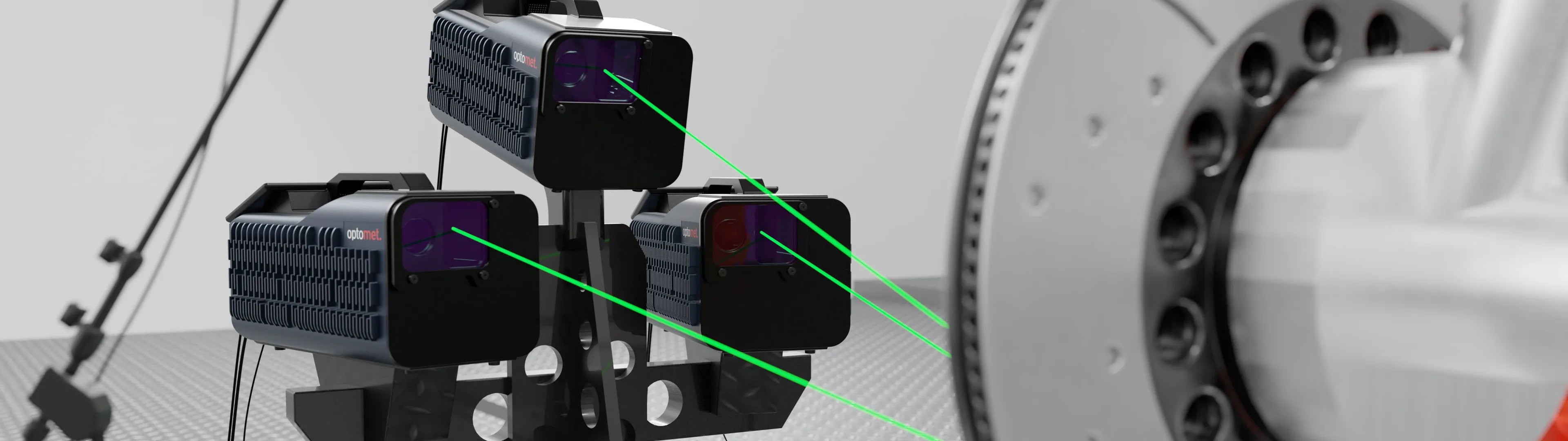
SWIR laser vibrometers.
- Measurement without surface preparation: Reliable measurement even on dark, matte, or fiber-reinforced surfaces—with no need for retroreflective tape or reflective sprays.
- Wide measurement range: Frequency bandwidth from DC to 50 MHz and vibration velocities of up to 50 m/s.
- Eye-safe without protective eyewear: Laser Class 1 with an output power below 10 mW—no special safety precautions required.
- Flexible working distances: From just a few millimeters to over 300 m – suitable for microstructures and long-distance measurements.
- Long service life: SWIR laser diodes do not require regular replacement – unlike HeNe tubes, which have a limited operating life.
SWIR laser vibrometers use invisible infrared light at a wavelength of 1550 nm. They deliver a high signal-to-noise ratio and provide reliable measurements on dark, rough, or highly absorbent materials.
What is a SWIR laser vibrometer?
SWIR stands for Kurzwellige Infrarotstrahlung and refers to the short-wave infrared region of the electromagnetic spectrum. Optomet SWIR laser vibrometers operate at a wavelength of 1550 nm—imperceptible to the human eye, yet offering physical properties that benefit vibration measurement.
With an output power below 10 mW, the SWIR measurement laser is classified as a Class 1 laser and is therefore eye-safe. Safety glasses are not required during normal operation. Since the laser beam is invisible, Optomet systems use a visible green pilot laser (510–530 nm, Class 2) for alignment with the measurement point. Alternatively, the SWIR spot can be made visible using an IR detector card.
Key Technical Specifications:
| Value | |
|---|---|
| Measurement laser wavelength | 1550 nm (invisible) |
| Pilot laser wavelength | 510–530 nm (green, visible) |
| Measurement laser class | Class 1, < 10 mW |
| Pilot laser class | Class 2, < 1 mW |
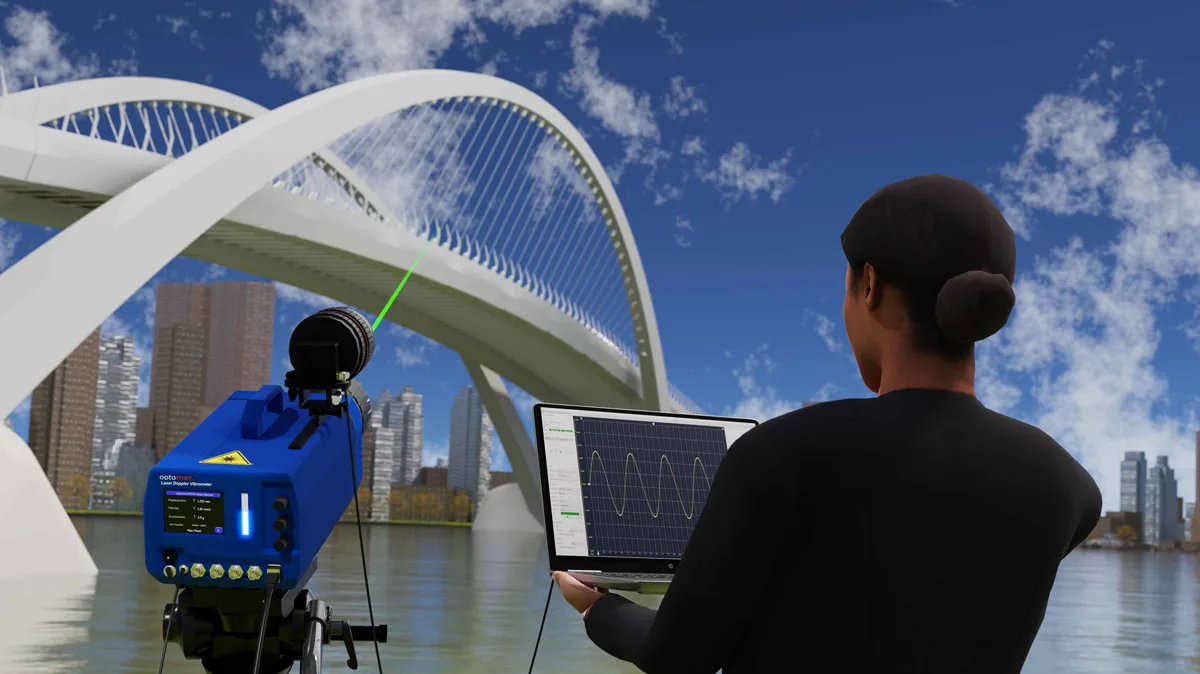
Why SWIR? – Technical Background & Benefits
The choice of laser wavelength directly affects measurement quality. Compared with visible HeNe lasers (632.8 nm), SWIR lasers at 1550 nm offer several physical advantages that deliver tangible benefits in practice.
Higher Signal-to-Noise Ratio
Within the same laser class, more laser power is available at 1550 nm than at 632.8 nm. SWIR systems operate at up to 10 mW (Class 1), while HeNe systems are limited to less than 1 mW (Class 2). The higher power budget improves the signal-to-noise ratio, particularly on low-reflectivity surfaces and over long measurement distances.
Unaffected by Thermal Radiation
SWIR detectors are largely insensitive to thermal emissions in the mid-infrared range. Measurements on hot surfaces—such as turbine blades or components in operation—are not affected by thermal radiation.
Long service life
SWIR laser diodes have a significantly longer service life than HeNe gas lasers. While HeNe tubes need to be replaced after approximately 10,000 operating hours, SWIR diodes generally operate throughout the entire service life of the instrument without requiring replacement.
Improved backscattering properties
Many engineering materials reflect more uniformly in the SWIR range than in the visible spectrum. Dark plastics, matte coatings, and fiber-reinforced composites provide a more stable backscattered signal at 1550 nm. This reduces signal dropouts and enables measurements without surface preparation—eliminating the need for retroreflective tape or reflective sprays.
SWIR or HeNe?
SWIR (1550 nm) is the standard choice for most applications—particularly for dark surfaces, fiber-reinforced composites, and long measurement distances.
HeNe (632.8 nm) is suitable for measurements through water or other liquids, as SWIR radiation is strongly absorbed by them.
 |  | |
|---|---|---|
| Wavelength | 1550 nm (invisible) | 632.8 nm (visible, red) |
| Laser class | Class 1, < 10 mW | Class 2, < 1 mW |
| Safety glasses required | No | No |
| Signal-to-noise ratio | Higher due to greater available laser power | Lower due to limited power |
| Surface preparation | Generally not required | Retroreflective tape or spray required depending on the surface |
| Measurement through water | No – strong absorption at 1550 nm | Yes – low absorption at 632.8 nm |
| Measurement on hot surfaces | Yes – insensitive to thermal radiation | Limited – thermal emissions may cause interference |
| Long measurement distances | Yes – over 300 m | Limited |
| Laser source lifetime | Long – no regular replacement required | Limited – HeNe tube ages |
| Spot size (with identical optics) | Larger due to the longer wavelength | Smaller due to the shorter wavelength |
| Optomet Products | SMART Series, Nova Series, Fiber Series | Vector Series, HeNe Scanning Vibrometer |
Optomet Laser Doppler Vibrometers with SWIR Lasers
Optomet uses SWIR technology as standard in most of its vibrometer systems. The products are divided into two series: the modular SMART Series and the CLASSIC Series.
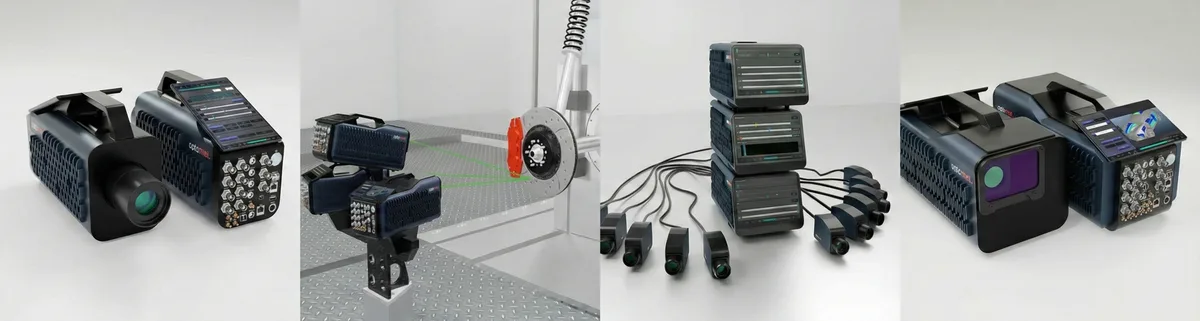
SMART Series
The SMART Series features a modular design and offers systems for a wide range of measurement tasks – from single-point measurements to full-field 3D analysis. All SMART products use SWIR lasers (1550 nm).
| Description | |
|---|---|
| SMART Single+ | Single-point vibrometer for precise measurements at a fixed measurement point |
| SMART Scan+ | Scanning vibrometer for full-field vibration analysis |
| SMART 3D Scan | Three synchronized scanners for three-dimensional vibration measurement |
| SMART Ganzkörper | Multiple networked scanners for large-scale objects such as vehicles or aircraft structures |
| SMART DAQ | Data acquisition system for simultaneous measurements at multiple points |
| SMART Multi-Fiber | Fiber-optic system with multiple sensor heads for parallel measurements |
| SMART 3D-Faser | Fiber-optic system for three-dimensional single-point measurements in hard-to-reach areas |
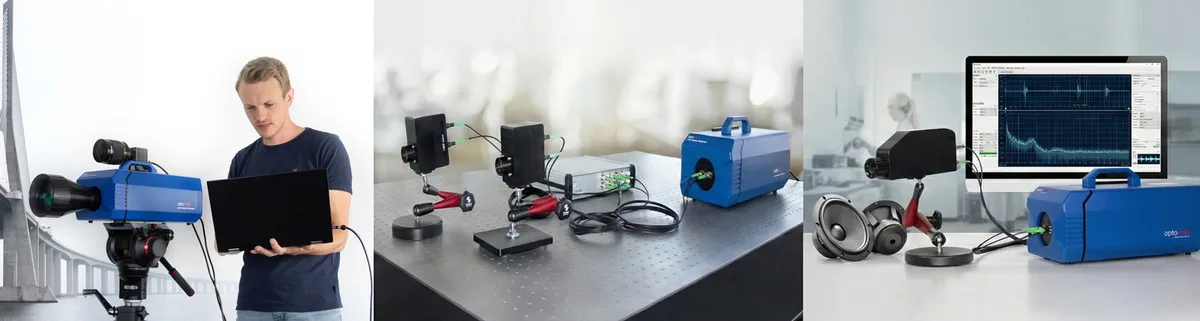
CLASSIC Series
The CLASSIC Series comprises standalone vibrometer systems for specific applications. SWIR technology is standard across this series as well.
| Description | |
|---|---|
| Nova Series | Single-point vibrometer for measurements on dark, rough, or biological surfaces |
| Nova Xtra | Long-range vibrometer for measurement distances of more than 300 m |
| Fiber Series | Fiber-optic single-point vibrometer for confined or hard-to-reach measurement locations |
| Faser-Multiplex | Fiber-optic system with switchable sensor heads for multiple measurement points |
| Scannendes Vibrometer | Scanning system for full-field vibration analysis |
FAQ: SWIR Laser Vibrometers
Is a SWIR laser vibrometer eye-safe?
Yes. The SWIR measurement laser operates at an output power below 10 mW and is classified as a Class 1 laser. Safety glasses are not required during normal operation. Infrared radiation at 1550 nm is absorbed by the fluid in the eye and does not reach the retina.
What wavelength does a SWIR laser vibrometer use?
Optomet SWIR vibrometers operate at a wavelength of 1550 nm in the short-wave infrared range. The measurement laser is invisible; a visible green pilot laser (510–530 nm) is used for alignment.
Does a SWIR laser need to be replaced?
Generally, no. SWIR laser diodes have a long service life and typically operate for the entire lifetime of the instrument without replacement. In contrast, HeNe tubes must be replaced after approximately 10,000 operating hours.
Are all Optomet vibrometers equipped with SWIR lasers?
Almost all of them. The entire SMART series and most products in the CLASSIC series (Nova, Fiber, Scanning Vibrometer) use 1550 nm SWIR lasers as standard. The only exception is the Vector Series, which uses a visible HeNe laser (632.8 nm) – ideal for measurements through water or on microstructures requiring a small spot diameter.
What are the limitations of a SWIR laser?
SWIR lasers are not suitable for every application. The main limitations are:
- Measurements through water: SWIR radiation is strongly absorbed by water. For measurements through liquids, a HeNe laser (632.8 nm) is more suitable.
- Spot size: With the same optics, a SWIR laser produces a larger spot than a HeNe laser – e.g., 89 µm vs. 30 µm at a distance of 500 mm (100 mm optics).
How do the maintenance requirements of SWIR and HeNe lasers compare?
SWIR laser diodes do not require regular replacement and need less maintenance. HeNe gas lasers are subject to natural aging – the tube must be replaced after approximately 10,000 operating hours.

Vibration measurement in research, development and industry – Optomet offers the right solution for your requirements.
Contact