3D laser vibrometers for vibration measurements in x, y and z.
- 3D scanning: Capture spatial mode shapes across defined measurement areas.
- 3D single-point: Measure x, y and z continuously at a fixed measurement point.
- Non-contact measurement: No additional sensor or cable mass at the measurement point.
- Validate FEM models: Compare direction-specific measurement data with the simulation model.
During vibration, not all areas of a component surface move in the same way. Amplitude, phase and direction of motion may differ from point to point. A 3D vibration measurement determines the motion components x, y and z. This enables spatial mode shapes and direction-dependent motion components to be analyzed separately.
Two methods for 3D vibration measurement
In 3D scanning, a defined component surface is measured point by point. At each measurement point, the system simultaneously captures the time histories of x, y, and z. This enables the frequency spectrum and the spatial vibration pattern of the surface to be determined.
With 3D-Single-Point, the three measurement directions remain focused on the same point throughout the entire process. The hardware continuously calculates x, y, and z. This captures the complete motion at that point, even during one-off or non-repeatable events.
3D scanning for spatial vibration patterns
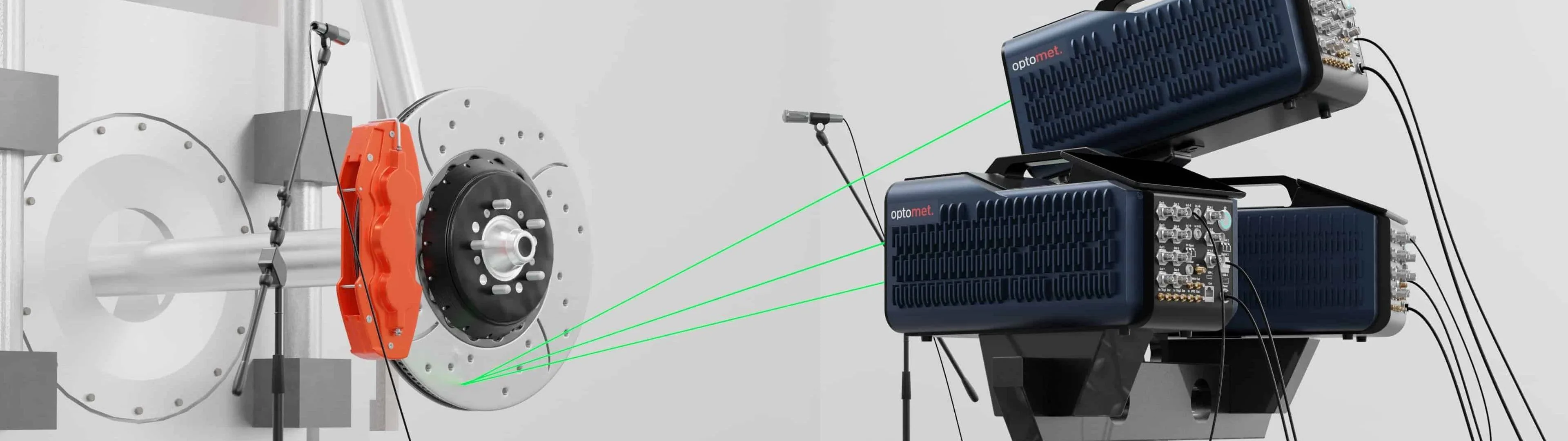
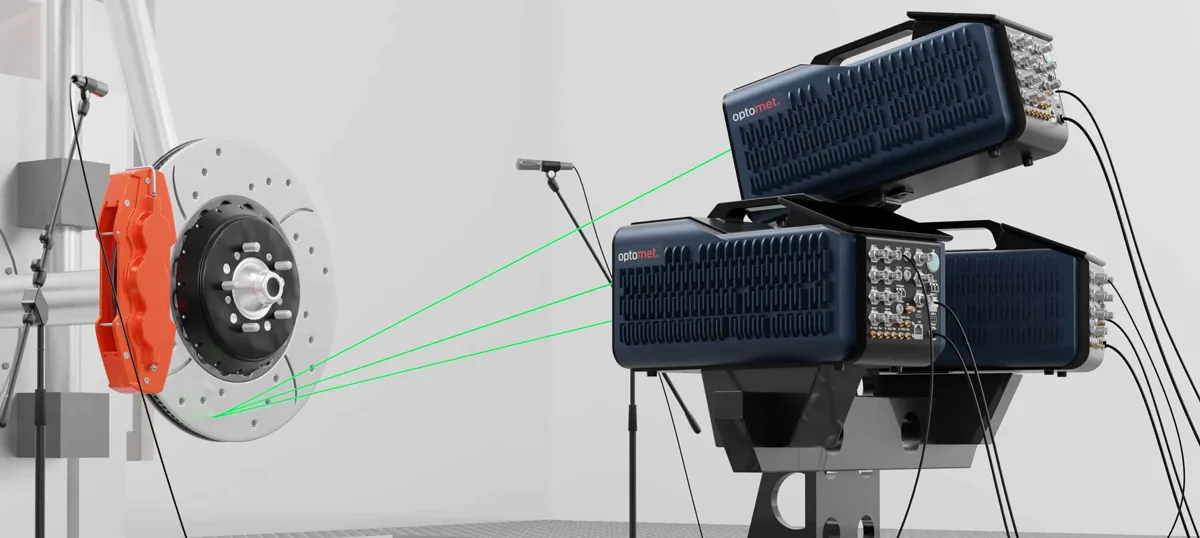
Three synchronized scanning vibrometers simultaneously measure each defined surface point from different directions. SMART Lab calculates x, y, and z from these signals and then moves to the next measurement point. This makes it possible to spatially identify bending and torsional components as well as in-plane and out-of-plane motion, and compare them with simulation data.
Typical applications:
- Operating deflection shape analysis (ODS) and NVH: Analyze spatial vibration patterns, local vibration maxima, and coupled bending, torsional, in-plane, and out-of-plane components.
- Experimental modal analysis (EMA): Determine natural frequencies, damping, and three-dimensional mode shapes based on a measured excitation.
- FEM correlation, model validation and model updating: Compare measurement and simulation data in the same coordinate system and at corresponding nodes. The measurement data can then be used to adjust material parameters, joints, mountings, and boundary conditions.
- Evaluate measures: Verify the effects of geometry changes, damping measures, or modified boundary conditions through comparative measurements.
Requirement: The vibration must be stationary or reproducible during the scan. A reference signal phase-aligns the points measured sequentially.
3D-Single-Point for continuous 3D measurements
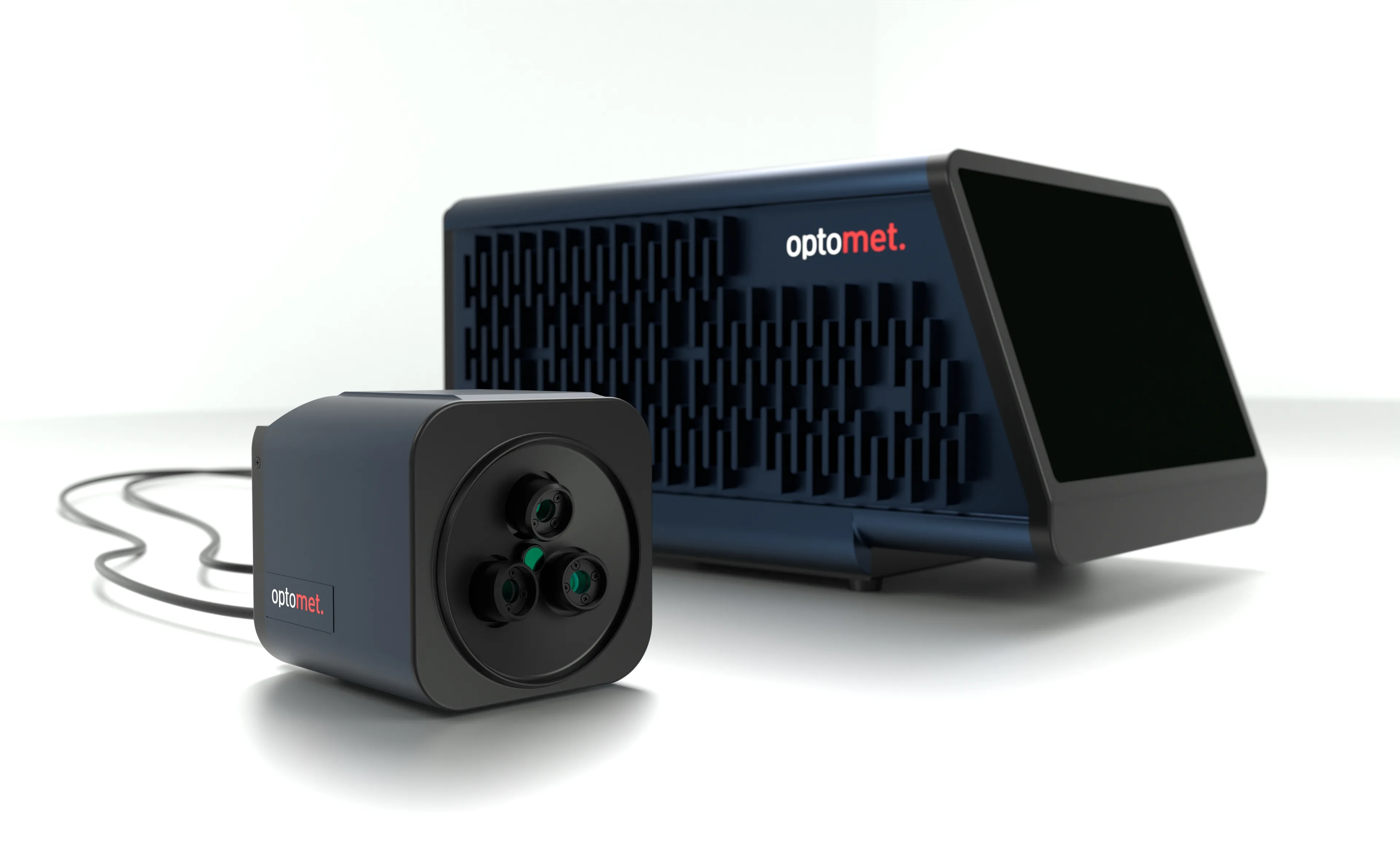
Three lasers remain focused on the same point throughout the measurement. Each measurement direction captures the motion component along its laser axis. The hardware continuously transforms the three measurement signals into x, y, and z and provides the components synchronously at the digital and analog outputs.
Typical applications:
- Transient and non-repeatable events: Capture the complete three-dimensional motion during impact, switching, run-up, or decay events.
- Process monitoring: Analyze directions of motion in machining processes, for example to investigate chatter vibrations or unstable process conditions.
- Small and lightweight components: Measure MEMS, printed circuit boards, electronic components and thin-walled structures where a triaxial accelerometer would affect the result due to its mass.
- Sensor and actuator testing: Non-contact measurement of the three-dimensional motion of small sensors, accelerometers, actuators or transducers.
- Hot or sensitive surfaces: Measure in three dimensions when sensor mounting is unsuitable due to temperature, material properties or surface sensitivity.
Requirement: All three lasers require an unobstructed line of sight to the measurement point.
Scope: This method provides the complete motion profile at a single point, but not a spatially resolved mode shape.
What is a 3D laser vibrometer?
A 3D laser vibrometer is an optical measurement system for non-contact acquisition of three-dimensional vibrations on component surfaces. Depending on the method, it measures either a fixed measurement point or multiple points across a defined surface.
At each measurement location, three laser beams approach the same surface point from different measurement directions. Each laser detects the component of motion along its beam axis. The three measured values are initially expressed in the beam coordinates u, v and w. The calibrated measurement geometry is then used to determine the x, y and z components in a defined Cartesian coordinate system.
For 3D single-point measurement, the instrument hardware performs this transformation continuously. For 3D scanning, SMART Lab subsequently calculates x, y and z for each acquired surface point and combines the results into a spatially resolved mode shape.
Measurement directions and coordinates
- Beam coordinates u, v and w: The directly measured motion components along the three laser axes.
- Cartesian components x, y and z: The components calculated from u, v and w in the defined coordinate system.
- In-plane components: The two motion components parallel or tangential to the local component surface.
- Out-of-plane component: The motion component normal to the local component surface.
- 3D vibration vector: The combination of x, y and z. It describes the magnitude and direction of motion at a measurement location.
What does a 1D laser vibrometer measure?
A 1D laser vibrometer measures vibration velocity or displacement along its laser axis. It therefore captures one component of motion, but not the complete direction of motion in x, y and z.
A 1D scanning vibrometer automatically repeats this measurement at many points on a surface. This creates a spatially dense measurement grid, but only one directional component is still captured at each point.
When is a 1D vibration measurement sufficient?
A 1D measurement is suitable when the relevant motion occurs predominantly in a known direction. A typical example is vibration analysis of thin body panels. Their bending vibrations are often primarily perpendicular to the local surface, i.e. Out-of-plane. If the panel is targeted approximately perpendicular to the laser beam, a 1D scanning vibrometer captures the relevant motion component at many points and visualizes its spatial distribution.
If tangential motions, coupled bending and torsional components, or the complete motion in x, y and z are also to be investigated, a 3D measurement is advisable.
Why the measurement angle matters
When the laser beam strikes a flat surface perpendicularly, it captures only the motion component normal to the surface, i.e. Out-of-plane. If the surface is targeted at an angle, components of Out-of-plane and In-plane motion contribute to the same measurement signal. A single laser cannot distinguish between these components.
On curved surfaces, the measurement angle changes from point to point. Therefore, multiple measurement directions are required if the motion is to be unambiguously separated into x, y and z.
How x, y and z are determined
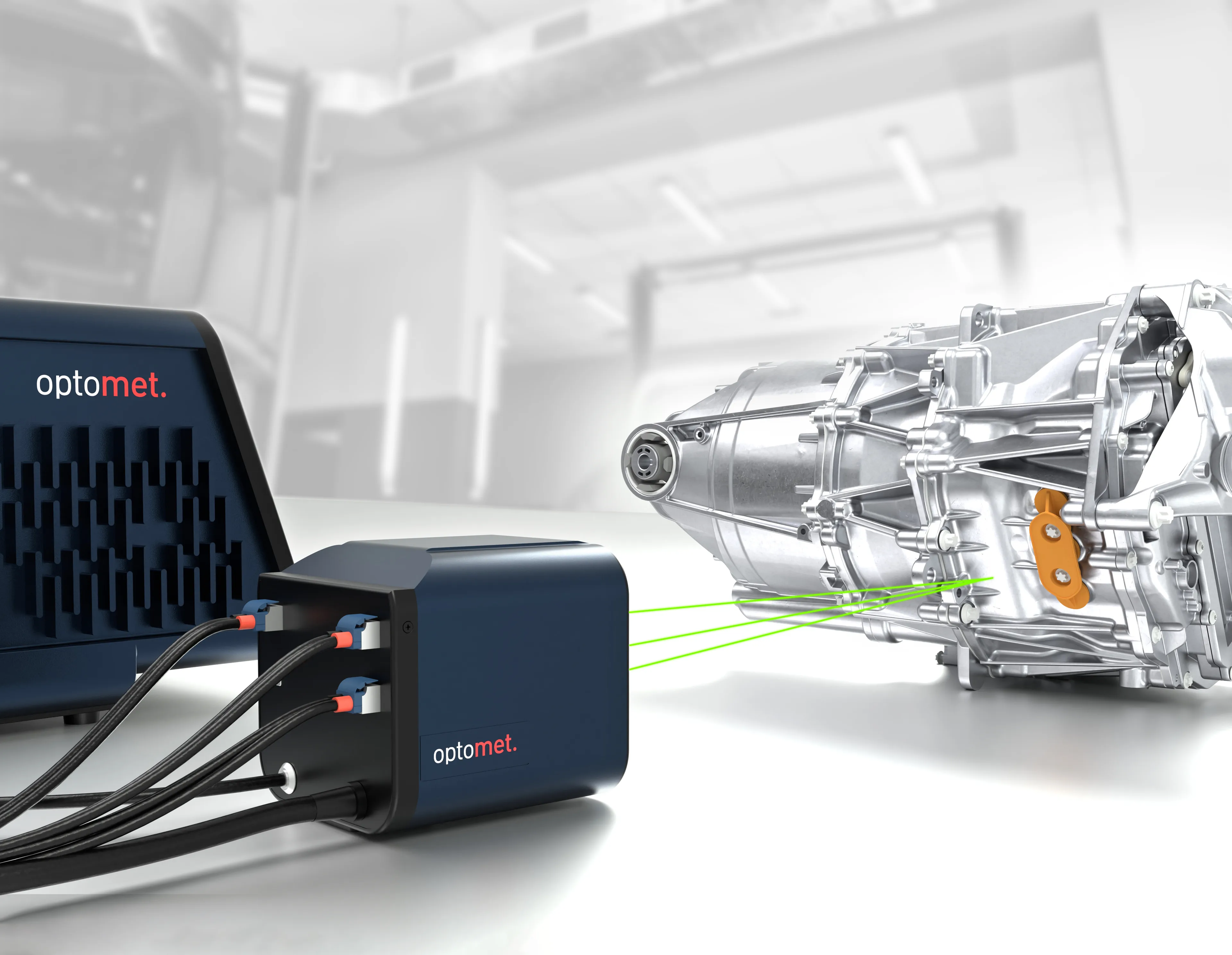
For 3D measurement, three lasers simultaneously capture the same surface point from different measurement directions. Because the spatial orientation of the lasers is known and calibrated, the three measurement signals can be transformed into the x, y and z components.
This allows In-plane and Out-of-plane motions, or radial, tangential and axial vibration components, to be evaluated separately. In 3D scanning, this measurement is automatically repeated at all defined points on the surface.
1D and 3D at a glance
- 1D-Single-Point: One directional component at a fixed measurement point.
- 1D-Scanning: One directional component at many sequentially measured points.
- 3D-Single-Point: x, y and z simultaneously and continuously at a fixed measurement point.
- 3D-Scanning: x, y and z simultaneously at each measurement point; the surface is captured point by point.
- Key point: More measurement points increase spatial resolution. Only additional measurement directions enable separation into x, y and z.
When is a 3D vibration measurement useful?
A 3D vibration measurement is useful when motion occurs in multiple directions and these components need to be evaluated separately. This applies in particular to curved surfaces, coupled bending and torsional vibrations, and direction-specific comparison with FEM data.
Brake disc example: evaluating In-plane and Out-of-plane separately
A brake disc can move normal to the surface as well as radially and tangentially within the plane of the disc. A 1D laser vibrometer captures only the component of motion along its laser axis. It cannot show how the motion is distributed across these directions.
3D measurement determines the x, y and z components separately. This makes it possible to identify whether an operating deflection shape is dominated by in-plane, out-of-plane or coupled motion.
The two videos show the same measured operating deflection shape of a brake disc at 5,984 kHz: the in-plane components on the left and the out-of-plane components on the right. Displaying them separately facilitates component-by-component comparison with the simulation and evaluation of design modifications or damping measures.
Curved surfaces and three-dimensional components
On curved surfaces, the local surface normal changes from point to point. As a result, a single laser captures different directional components of motion at different locations.
A 3D measurement separates the motion at each point into x, y and z in the selected coordinate system. This enables directional components to be compared, for example, on turbine blades, housings, brake discs or deep-drawn sheet metal parts.
Coupled bending and torsional vibrations
In coupled bending and torsional vibrations, the surface moves simultaneously in several directions. A 1D measurement shows the component of motion along the laser beam, but not how the overall motion is distributed among the individual directions.
3D measurement displays, for example, axial, radial and tangential components, or the x, y and z components, separately.
FEM correlation and Model Updating
An FEM model provides directional displacements at every node. For a reliable comparison, measurement and simulation data must be available at corresponding points and in a common coordinate system.
The 3D measurement data enable component-by-component comparison and can serve as a basis for Model Updating of material parameters, joints, bearings and boundary conditions.
Evaluate design modifications effectively
A comparative measurement before and after a change shows which directional components and operating deflection shapes have changed. This makes it possible to verify whether a geometry modification, damping measure or changed mounting arrangement has the intended effect.
The measurement results can then be compared with the FEM model predictions.
Optomet systems for 3D vibration measurement
Optomet implements both measurement methods with systems from the SMART series. SMART 3D-Scan captures x, y and z across a defined component surface. SMART 3D-Fiber continuously measures the three components at a fixed point. Both systems operate without contact and can be integrated into SMART Lab or existing measurement chains.
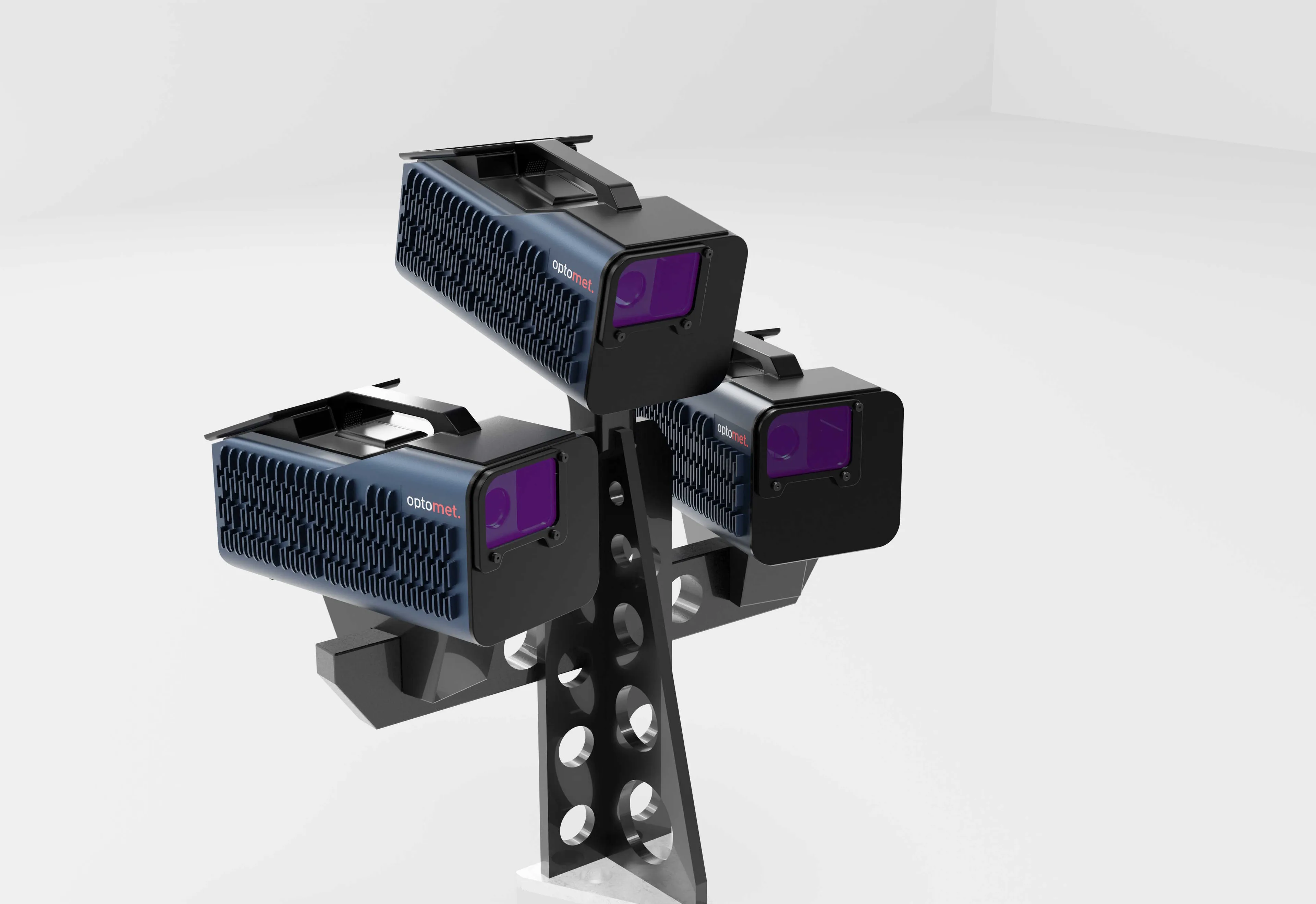
SMART 3D-Scan: automatically capture three-dimensional operating deflection shapes
SMART 3D-Scan combines three synchronized SMART Scan+ vibrometers. At each defined measurement point, all three instruments capture the same surface point simultaneously from different directions. SMART Lab calculates x, y and z from these data and then moves to the next measurement point. This automatically captures the entire defined measurement area.
- Result: Spatially resolved operating deflection shapes with separate x, y and z components. With a measured excitation, three-dimensional mode shapes can also be determined from an experimental modal analysis.
- Seamless workflow: Import a CAD or FEM model, define measurement points, calibrate the system, start the scan and evaluate the results – all steps remain within a single SMART Lab project.
- Modular design: Each SMART Scan+ can also be used independently as a complete 1D scanning vibrometer. Existing systems can be expanded to 3D or into larger synchronized measurement setups.
- Typical tasks: operational vibration analysis, experimental modal analysis, NVH, FEM correlation, model validation and Model Updating.
SMART 3D-Fiber: continuously measure x, y and z at a single point
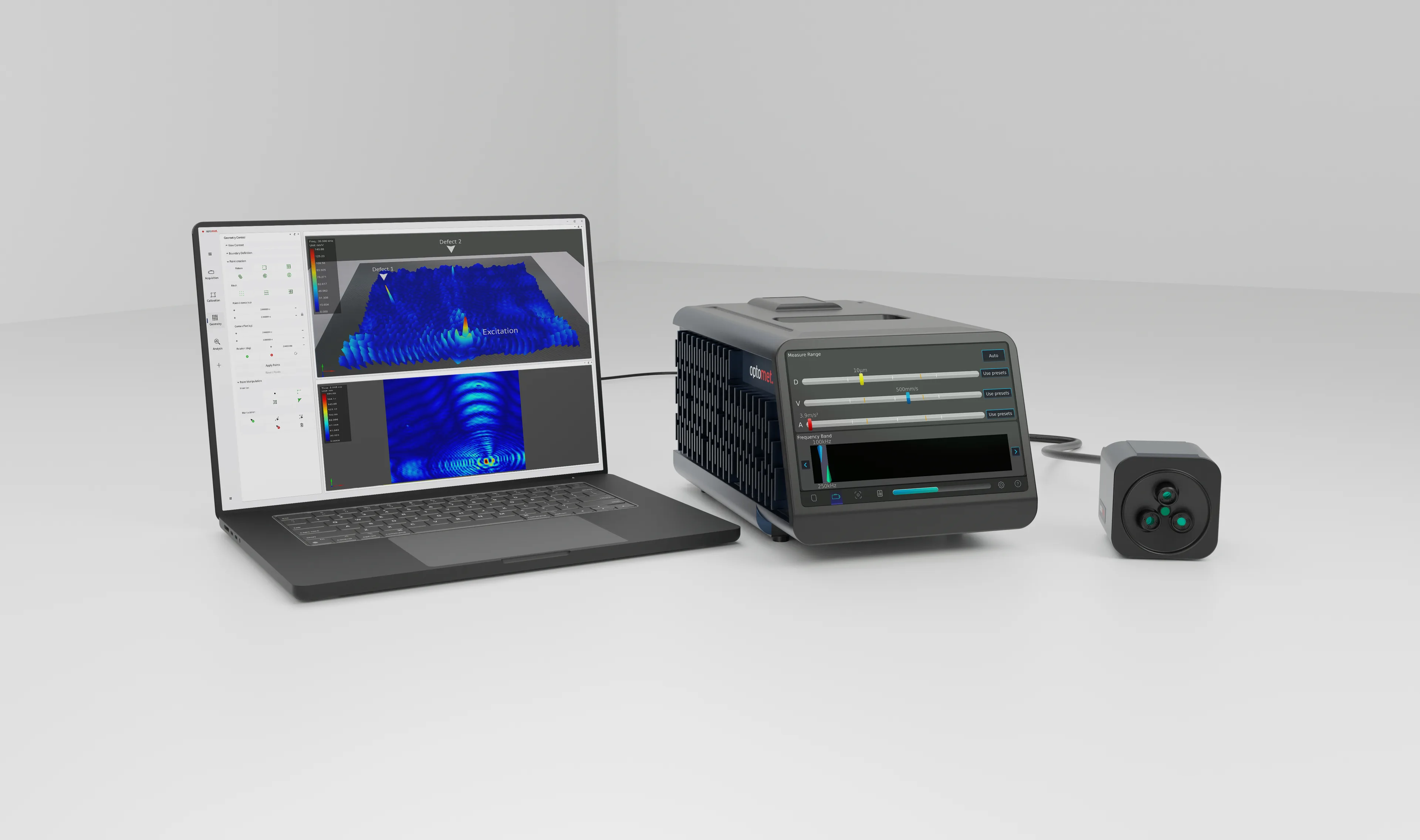
With SMART 3D-Fiber, three laser beams remain aligned with the same surface point throughout the entire measurement. The device hardware continuously transforms the three measurement signals into x, y and z and provides the components synchronously at the digital and analog outputs. This captures the complete three-dimensional motion at that point.
- Temporal behavior: Suitable for continuous, rapidly changing, one-time and non-repeatable processes.
- Typical tasks: process monitoring, investigation of small and lightweight components, PCB and electronics testing, and testing of sensors, actuators and transducers.
- Integration: Use with SMART Lab or output of the synchronous x, y and z signals to an external data acquisition system.
- Alignment: An integrated camera helps align the three lasers to the same point. All three lasers require a clear line of sight to the measurement point.
Typical applications of 3D vibration measurement
3D scanning is suitable when motion needs to be spatially resolved across a component surface. 3D single-point measurement is used when x, y and z need to be continuously captured at a fixed measurement point throughout an entire process. The following examples show typical measurement tasks for both methods.
FEM validation on turbine blades and blisks
Suitable method: 3D scanning
Turbine blades and blisks have curved surfaces and often exhibit coupled bending and torsional vibrations. A 3D scan determines x, y and z at many defined surface points and can map them to the nodes of an FEM model.
In an experimental modal analysis with measured excitation, natural frequencies, damping and three-dimensional mode shapes can be compared with the simulation component by component. The measurement data can then serve as a basis for validation and Model Updating.
Investigating NVH and brake noise
Suitable method: 3D scanning
Brake discs, housings and vehicle components can move simultaneously in radial, tangential and surface-normal directions at the same frequency. A 3D scan separates these directional components and shows their spatial distribution across the component.
This enables relevant vibration modes to be compared component by component with an FEM model. Comparative measurements then show how changes in geometry, mounting conditions or damping measures affect the individual directions of motion.
Testing lightweight components as well as sensors and actuators
For thin-walled housings, circuit boards, lightweight composite components or small precision mechanisms, a triaxial accelerometer can affect measurement results due to its mass and connected cables. Depending on the component, this can alter natural frequencies, damping and vibration amplitudes.
3D-Single-Point continuously measures x, y and z at a fixed point without loading the component with a sensor. The method is also suitable for testing accelerometers, piezo actuators and transducers when transverse motions and couplings are to be investigated in addition to the intended primary motion.
Process monitoring and transient events
Suitable method: 3D-Single-Point
During machining, run-up, switching, impact or decay processes, motion can change within a short period of time. Some events cannot be reproduced reliably.
With 3D-Single-Point, all three lasers remain aligned with the same measurement point. This allows x, y and z to be captured simultaneously and continuously throughout the entire process. It can therefore be used to investigate changes in direction, chatter vibrations and unstable process conditions, for example.
3D scanning with SMART Lab
SMART Lab combines measurement planning, instrument setup, measurement and analysis in a single project. Measurements can be prepared in advance using a CAD or FEM model. In the lab, the project is loaded, the setup is automatically registered and the scan is started. Initial results are visible during the measurement. There is no need to re-enter measurement points or switch between different programs.
1. Define measurement points
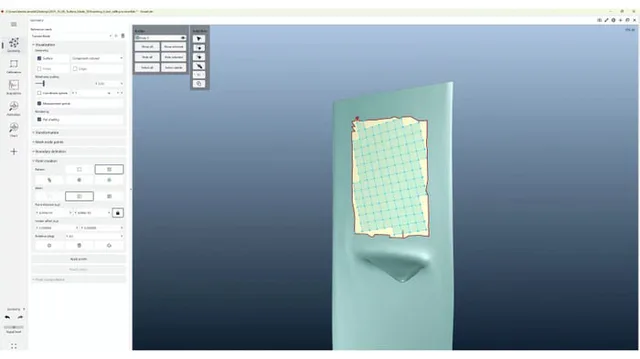
A CAD or FEM geometry is imported into SMART Lab as an STL, OBJ or NASTRAN file. Measurement points can be defined directly on the surface or at selected FEM nodes.
The project can be prepared offline, for example by the simulation engineer, and then used in the lab without modification.
2. Automatically register the system
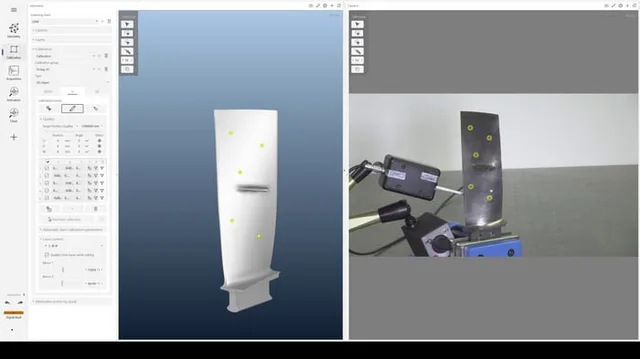
In the lab, the three vibrometers are aligned with the measurement surface. SMART Lab matches the camera images to the model, determines the positions of the instruments and automatically calibrates the three measurement directions.
In a typical setup, alignment takes less than one minute per instrument. Automatic calibration takes approximately one to two minutes and immediately indicates whether the achieved quality is sufficient for the measurement.
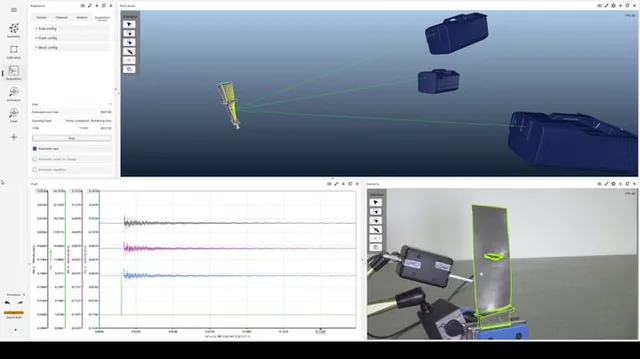
3. Start the scan and analyse the results
Once started, the system automatically measures the defined points. Signal quality and interim results are already visible during the scan. This enables the measurement setup and settings to be checked at an early stage.
SMART Lab calculates the x, y and z components from the three measurement directions. The software displays time data, spectra and operating deflection shapes. For measurements with recorded excitation, FRFs and three-dimensional mode shapes can also be analysed. Measurement data can be exported as MATLAB, UFF, ATFX or HDF5 files, and animations as MP4 files.
3D-Single-Point with SMART 3D-Fiber
For the measurement, the 3D fiber head is aligned with a fixed measurement point. The instrument hardware then continuously calculates the x, y and z components. All three components are captured simultaneously, preserving their time and phase relationships in full. This is particularly suitable for transient, rapidly changing or non-repeatable processes.
Step 1: Establish the connection
The 3D fiber head is positioned so that all three lasers strike the same point on the surface. The integrated camera shows the laser positions and supports precise alignment.
For the measurement, all three lasers require an unobstructed line of sight and a sufficient optical backscatter signal. The measurement head then remains aligned with this point throughout the entire process.
2. Start the measurement and output x, y and z
After the measurement parameters have been configured, the measurement is started. The device hardware continuously transforms the three signals from the beam directions u, v and w into x, y and z.
The synchronized time histories are available in SMART Lab as well as at the digital and analog outputs. This also allows them to be integrated into external DAQ systems, test benches or process monitoring systems. Additional excitation is only required if it is necessary for the respective measurement task.

Which measurement method is right for your application? An Optomet application engineer will review your measurement task free of charge and recommend the appropriate method and measurement setup.
Have your measurement task reviewedFAQ: 3D Laser Vibrometers
What is the difference between a 1D and a 3D laser vibrometer?
A 1D laser vibrometer measures vibration along the direction of the laser beam – that is, exactly one component. A 3D laser vibrometer uses three laser beams to measure all three spatial directions and provides the complete vibration vector in Cartesian coordinates (x, y, z).
When is a 3D laser vibrometer needed?
A 3D laser vibrometer is required when in-plane vibrations are relevant, when complex geometries with curves or freeform surfaces need to be analyzed, or when FEM validation must be performed using complete 3D displacement vectors.
What do “in-plane” and “out-of-plane” mean?
“Out-of-plane” refers to vibrations perpendicular to the surface (normal motion). “In-plane” refers to vibrations within the material plane, i.e. tangential to the surface. Only a 3D laser vibrometer can reliably distinguish between these components.
How does the conversion to Cartesian coordinates work?
The three lasers initially measure in their respective beam directions (u, v, w). The SMART Lab software automatically calculates the vibration components in a Cartesian coordinate system (x, y, z) – aligned with the test object or the FEM model.
What is the difference between 3D scanning and 3D single-point measurement?
A 3D single-point vibrometer (SMART 3D-Fiber) measures three-dimensional vibration at a fixed measurement point. A 3D scanning vibrometer (SMART 3D-Scan) automatically moves sequentially across many points and delivers complete 3D mode shapes over an entire surface.
Can an existing 1D system be upgraded to a 3D system?
Yes. The SMART Series has a modular design. An existing SMART Scan+ can be expanded with two additional units at any time to create a complete SMART 3D-Scan.
Which 3D models can be imported?
SMART Lab supports common formats such as STL, OBJ and PLY, as well as FEM models from NASTRAN. Measurement points can be placed directly on FEM nodes.
How is calibration performed in a 3D scanning system?
The three laser beams are calibrated fully automatically in SMART Lab. The software verifies calibration quality and displays mathematical error calculations.
What frequency range can be measured with a 3D laser vibrometer?
With the SMART Series, frequencies from DC to 50 MHz can be measured.
Is load and stress calculation possible?
Yes. Strains and the resulting stresses can be calculated using the complete 3D displacement vectors—as an alternative to strain gauges.
Which laser class is used?
The SMART 3D Vibrometers use eye-safe laser sources. The invisible SWIR measurement laser (1550 nm) is classified as laser class 1 (< 10 mW) and requires no protective eyewear. The visible pilot laser used for alignment is laser class 2 (< 1 mW) and is also eye-safe.
Are the measurement points acquired simultaneously or sequentially?
The three lasers of a 3D system measure the same point simultaneously from different angles. In a 3D scanning vibrometer, the individual measurement points are scanned sequentially. Using a reference signal, the time-shifted measurements are combined with phase correction.
How is the test object excited?
The excitation depends on the measurement task and can be provided using a modal hammer, a shaker, a piezo actuator, or under real operating conditions. The SMART series features an integrated signal generator that can be used as a defined excitation source.
Can a 3D laser vibrometer be integrated into automation environments?
Yes. Measurement data are available in both digital and analog form and can be integrated into existing test benches and measurement chains via open interfaces. External triggers enable synchronized measurement processes.
What working distance is possible?
SMART 3D-Scan: The system enables working distances from approx. 6.5 mm to 100 m, depending on the object size and setup.
SMART 3D-Fiber: The compact 3D-Fiber Head has a fixed working distance of 83 mm. Alternatively, additional Fiber Heads with working distances from 25 mm to 100 m are available.