
Signal Processing
From the photodetector to reliable measurement results: demodulation, filtering, sampling rate, FFT, and noise floor determine the quality of vibration data.
4 min readVibration Measurement & Signal Analysis
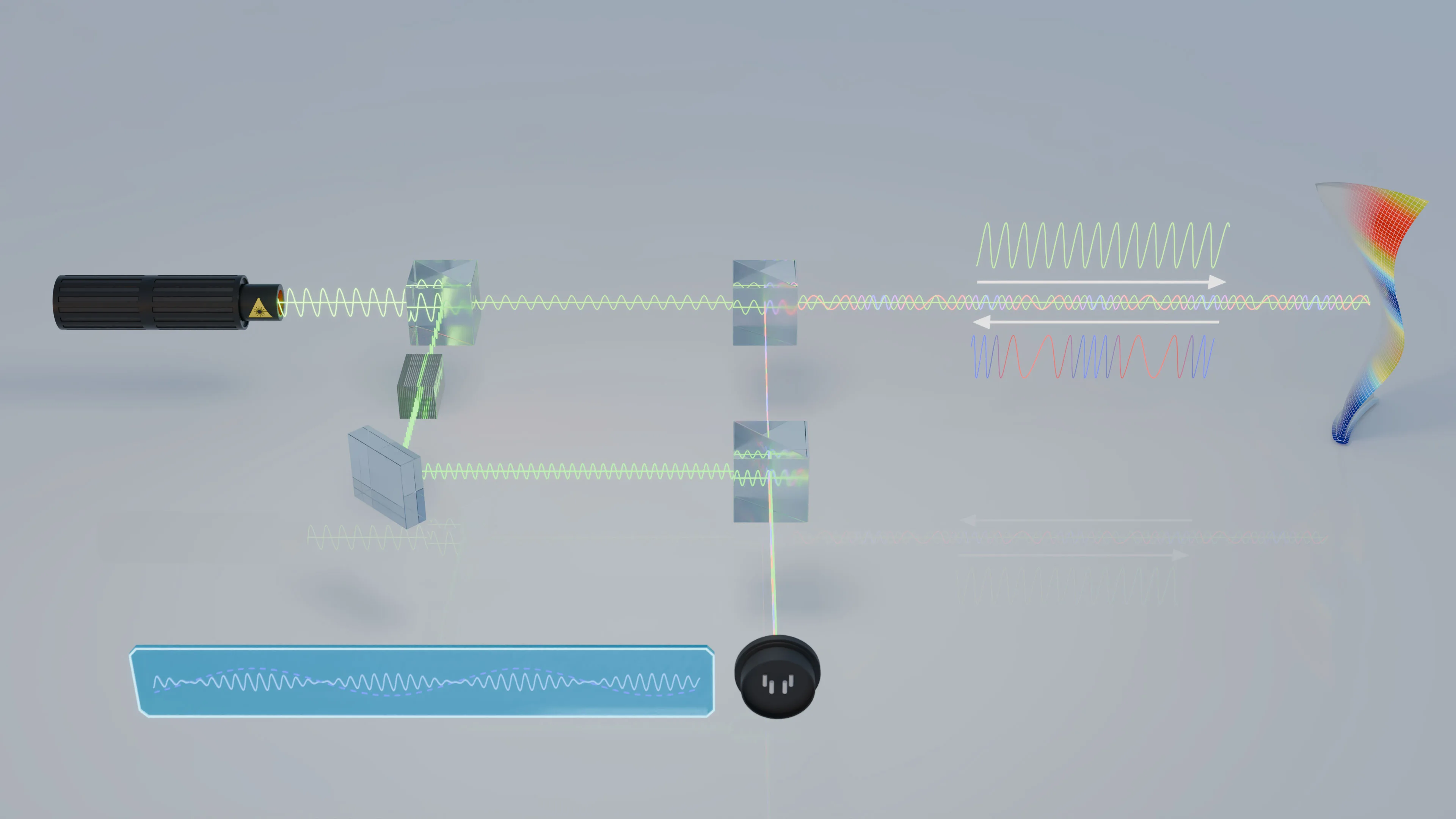
Signal processing involves analyzing and modifying signals to extract useful information for a wide range of applications.
Fundamentals of Signal Processing
Signal processing is a broad field of engineering and computer science concerned with analyzing, modifying, and synthesizing signals to extract information. This information may be contained in a signal in the form of electrical, acoustic, or imaging data, for example. Digital and analog signal processing differ in how signals are processed. While analog signal processing deals with continuous signals, digital signal processing (DSP) uses discrete signals. Digital signal processing is one of the foundations of today's digital world and affects virtually every aspect of life.
Processing Sensor Signals
Data is often recorded as time-domain signals by a wide range of sensors. These sensors detect physical phenomena such as temperature, pressure, or light and convert them into electrical signals for further processing. The ability to capture and analyze these signals accurately is essential for applications in medicine, communications engineering, automation, and many other fields.
Digital and Analog Signal Processing
Before digital signal processing, continuous analog signals are converted into discrete digital signals by an analog-to-digital converter (ADC). These digital signals can then be processed using digital signal processors or computers. Digital signal processing offers several advantages:
- Reproducible and precise results: Environmental factors and component tolerances have little impact on data processing
- Flexible options: Rapid development and cost-effective modification of signal processing
- Straightforward implementation using established algorithms
- Secure storage and efficient transmission of digital data
- Improved signal-to-noise ratio through adaptation to the data
Signal Processing Fundamentals and Techniques
Algorithms for tasks such as mixing, filtering, transforming, or controlling a signal form the basis of signal processing. They combine various mathematical operators and concepts to generate a new signal from parts of one or more signals. Key concepts include convolution, filtering, and the Fourier transform.
Convolution and Digital Signal Processing Filters
Convolution is a mathematical operation that combines two functions to produce a third. In digital signal processing, convolution is frequently used to perform filtering operations. Filters can take various forms, including low-pass, high-pass, band-pass, and notch filters. They are used to remove unwanted frequency components from a signal or emphasize specific frequency ranges. This enhances the data during signal processing, for example through smoothing or noise reduction.
Using the Fourier Transform
The Fourier transform is a key element of signal processing, converting a signal from the time domain to the frequency domain. This technique is essential because many signals are easier to analyze and manipulate in the frequency domain. The fast Fourier transform (FFT), an efficient implementation of the Fourier transform, enables engineers to quickly identify and analyze a signal's frequency components.
The Role of Difference Equations in Signal Processing
Difference equations are an essential tool in signal processing. They are recursive equations that describe the current value of a discrete time series in terms of its previous values and input values. They enable the behavior of a signal to be modeled and analyzed systematically. In digital signal processing, difference equations are frequently used to design and implement digital filters because they provide a mathematically rigorous method for describing signal transformations.
Mathematical Representation
Difference equations are usually expressed in the form y(n) = ∑ₖ₌₀ᴺ aₖ x[n−k] + ∑ₘ₌₁ᴹ bₘ y[n−m], where y(n) is the current output value, x(n) is the current input value, and ak and bm are the filter coefficients. This equation shows how the current output value is determined by a weighted sum of the current and previous input values and the previous output values. By selecting suitable coefficients, various filter characteristics, such as low-pass, high-pass, band-pass, or band-stop filters, can be implemented.
Use in IIR and FIR Filters
In practice, difference equations enable the implementation of filters with an infinite impulse response (IIR) and a finite impulse response (FIR). IIR filters, which are described by recursive difference equations, use both previous input and output values and can achieve complex filter characteristics with less computational effort. FIR filters, by contrast, use only previous input values and are always stable, but often require more complex calculations.
Importance for Digital Signal Processing
Difference equations allow digital filters to be specified precisely and implemented efficiently. This is particularly important in laser Doppler vibrometers, where large volumes of data must be processed digitally, precisely, and in real time, making computing performance critical. The mathematical precision and flexibility of difference equations make them an indispensable tool for developing and applying modern signal-processing algorithms. They enable complex signals to be analyzed and manipulated, significantly improving the quality and efficiency of signal processing.
Review and Outlook
In summary, signal processing is a diverse and extensive field encompassing numerous techniques and tools. From convolution in digital signal processing to the use of the Fourier transform, signal processing underpins many modern technologies and applications. The precise acquisition and processing of signals is essential in many technical and scientific fields and continues to advance through ongoing research and innovation.