


 SMART Scan+
 SMART 3D-Scan
 SMART Full Body
 SMART Single+
 SMART Multi-Fiber
 SMART 3D-Fiber
 SMART DAQ
 Software SMART Lab
 Scanning Vibrometer
 Vector-Series
 Vector-Micro-Optics
 Nova-Series
 Nova-Xtra
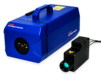 Fiber-Series
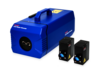 Fiber-Multiplex
 Fiber Micro Manipulator
 OptoSCAN
 OptoGUI
 Single-Point Vibrometers
 Scanning Vibrometers
 3D-Laser Vibrometers
 Support & Datasheets
 Acoustics & Ultrasonics
 Aerospace and aviation
 Automotive
 Biology & Medicine
 Brake noise
 Civil Engineering
 Electronics & Household Devices
 Materials Research
 Medical technology
 Tools & Machinery
 Turbine
 Wind tunnel testing
A long distance vibration sensor is a measurement system designed to detect mechanical vibrations on objects that are located far from the sensor itself. While the term is often associated with conventional contact-based sensors, the underlying requirement – measuring vibrations at a significant standoff distance – increasingly points toward non-contact technologies.
- Products
- Applications
- Knowledge
- Optomet

Optomet GmbH
Uhlandstraße 9
64297 Darmstadt
Mail:
sales(at)optomet.de
Phone: +49 6151 38432-0

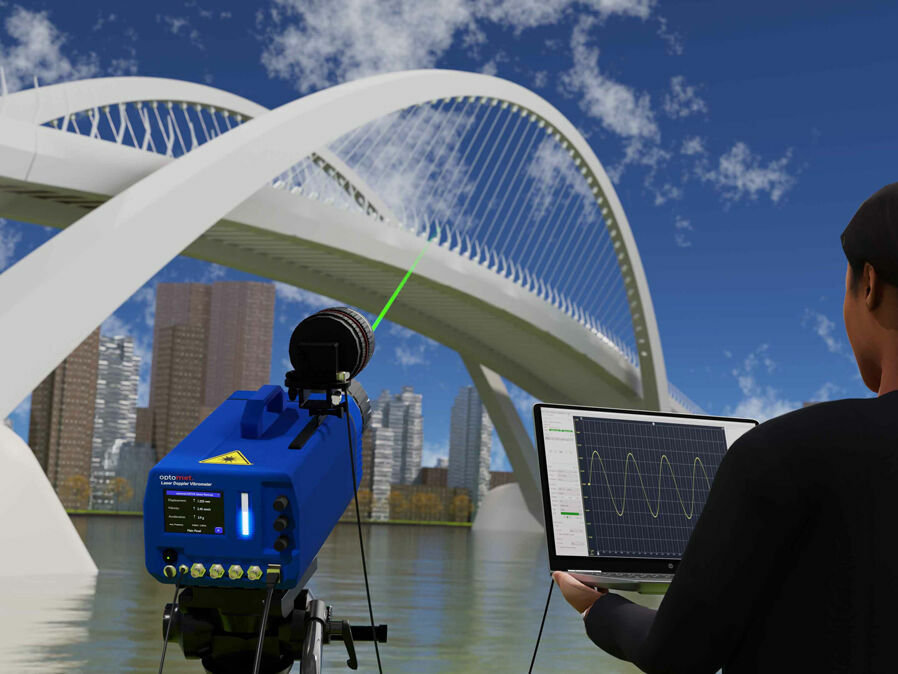
What Is a Long Distance Vibration Sensor?
Conventional vibration sensors such as accelerometers, strain gauges, or velocity transducers require direct physical attachment at the measurement point. While they provide reliable data, their application depends on direct access to the structure. At standoff distances of tens or hundreds of meters, this requirement becomes the limiting factor.
Non-contact vibration sensors, specifically laser-based systems, address this limitation: They direct a laser beam at the object's surface and detect the vibration optically, without touching the structure. This allows measurement at distances that are impractical or impossible for conventional sensors.
Contact sensor
- Physical attachment required
- Cable connection to DAQ
- Adds mass to structure
- Access to mounting point needed
Non-contact (laser)
- No mounting – laser beam replaces sensor
- No cabling to measurement point
- Zero mass influence
- Measurement from safe distance
Laser Doppler Vibrometry for Long Distance Measurements
Laser Doppler vibrometry (LDV) is an optical, non-contact measurement principle that detects surface vibrations at standoff distances from millimeters to several hundred meters.
A laser Doppler vibrometer directs a laser beam at the surface of the object under test. When the surface vibrates – i.e., it moves toward or away from the instrument – the frequency of the reflected light shifts proportionally to the surface velocity. This is the Doppler effect, applied to light.
The vibrometer detects this frequency shift interferometrically and decodes it into velocity, displacement, and acceleration signals. The measurement is entirely optical: no sensor is mounted on the structure, no cable is routed to the measurement point, and the object's vibration behavior remains completely unaffected.
Why LDV is suited for long distances
The laser beam travels at the speed of light, carries no mass, and can reach any surface within line of sight. The achievable standoff distance depends on the instrument's optical design – aperture size, laser power, and focusing capability – as well as the surface properties of the target.
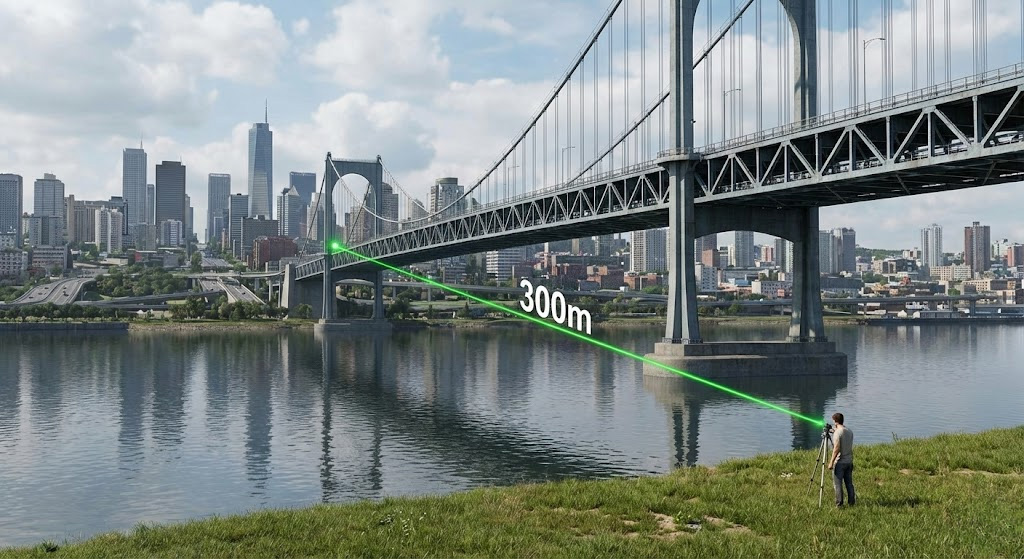
Modern laser vibrometers operating in the Short-Wave Infrared (SWIR) range at 1550 nm achieve standoff distances of over 300 m.
Typical Applications for Long Distance Vibration Measurement
- Large measurement distances, for example on large structures such as bridges, buildings or support structures
- Limited physical access to the object under test due to size, geometry or operational constraints
- Safety-critical environments, including explosive atmospheres, high-voltage areas or zones with elevated temperatures
- Hot, moving or operating structures, such as hot piping or rotating machinery
- Rough or contaminated surfaces where reliable sensor mounting is not possible, for example in mining or heavy machinery
- Objects that must not be instrumented, such as historic or protected buildings where non-invasive measurement is required
Why Conventional Vibration Sensors Reach Their Limits
Contact-based vibration sensors are well established in many measurement environments. However, for long distance applications, they present practical limitations:
- Cabling and installation effort: Every contact sensor requires signal cables, power supply, and often additional signal conditioning hardware. Over long distances, cabling becomes a significant cost and logistical factor.
- Repositioning and repeated setup: When multiple measurement points are needed on a large structure, each point requires a separate sensor installation. Repositioning means repeating the full mounting and calibration process.
- Troubleshooting complexity: If signal quality degrades or a channel fails, identifying the cause in a long cable run with multiple connection points is time-consuming. The source of error can be the sensor, the cable, the connector, or the mounting itself.
- Access and safety constraints: Mounting sensors on bridges, towers, or high-rise buildings requires physical access – often involving scaffolding, climbing equipment, or aerial platforms. Near high-voltage equipment or in restricted zones, safe sensor installation may not be possible at all.
Optomet Solutions for Long Distance Vibration Measurement
Optomet develops and manufactures laser Doppler vibrometers for non-contact vibration measurement. The product range includes single-point, scanning, and multi-channel systems for applications across research, development, and industrial testing.
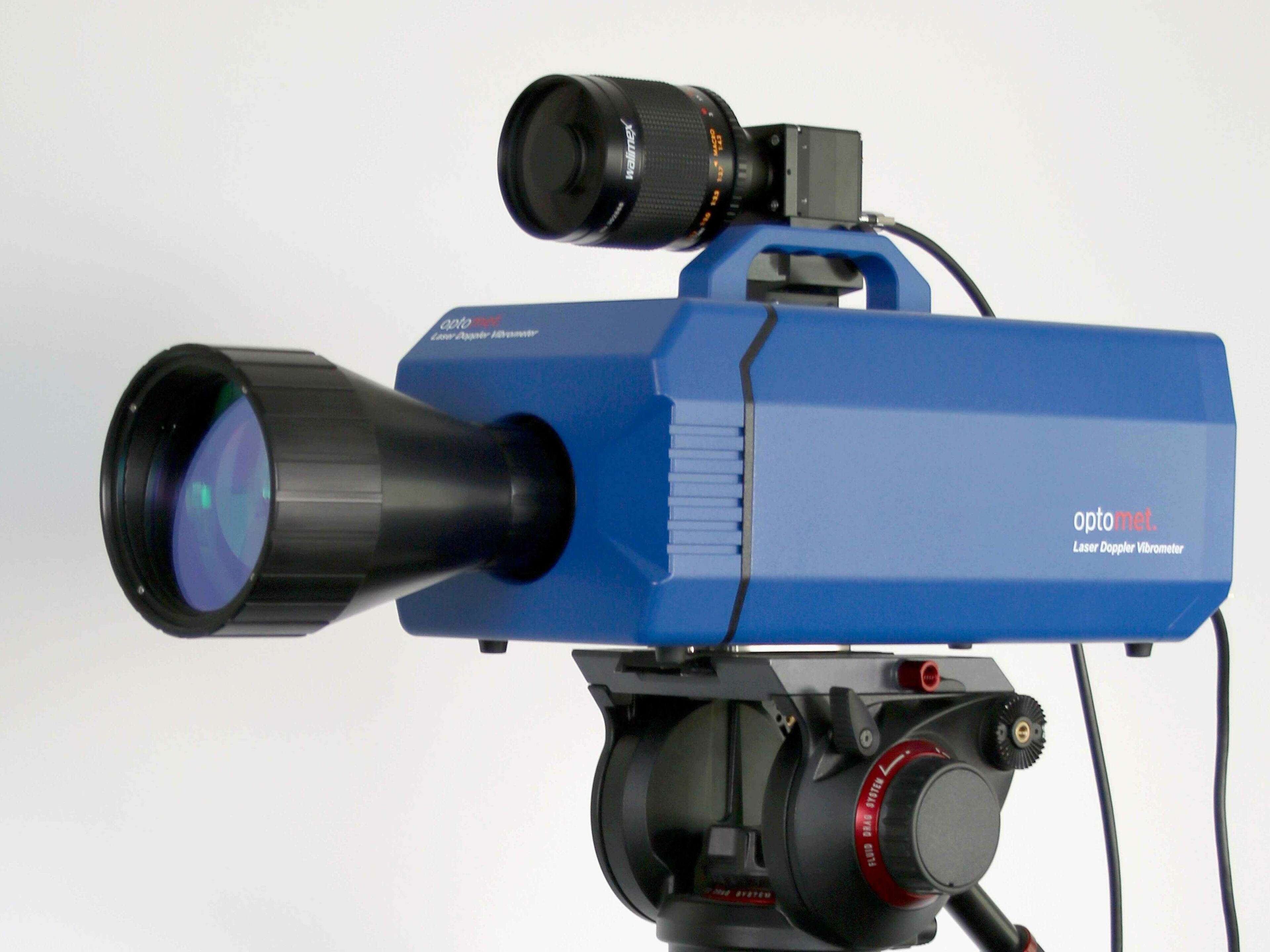
For long distance vibration measurement, Optomet offers a dedicated system configuration within the CLASSIC Nova Series – the Nova-Xtra.
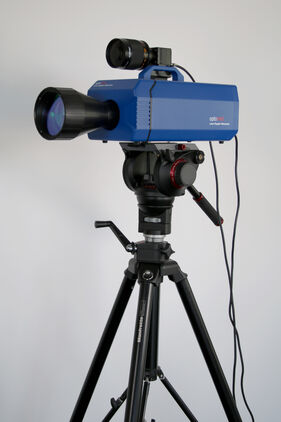
Nova-Xtra: Long Distance Laser Vibrometer
The Optomet Nova-Xtra is an extension of the Nova Series, engineered for vibration measurements at standoff distances of over 300 m. It operates with an invisible SWIR laser (1550 nm), which provides improved backscattering on dark and rough surfaces and reduces sensitivity to ambient light.
Key characteristics:
- Working distance from 2.49 m to over 300 m
- Frequency bandwidth from DC to 25 MHz
- Measured quantities: velocity, displacement, and acceleration
- Large-aperture front optics for increased signal collection at long range
- Optional SWIR camera for infrared laser spot visualization
- 3× analog outputs and digital interface (1 Gbit Ethernet)
The Nova-Xtra is designed for structural vibration analysis of bridges, towers, high-rise buildings, and large industrial installations – wherever non-contact measurement at long range is required.
Get Expert Advice for Your Application
Every measurement task is different. Standoff distance, surface material, frequency range, and environmental conditions all influence the choice of instrument and configuration. We help you determine the right setup for your specific application.

CallNow
Europe: 9:00am - 5:00pm (UTC+1)
Americas: 3:00am - 12:00pm (UTC-5)
Asia: 3:00pm - 0:00am (UTC+8)
CallBack